Ephesus: how to get there, ticket prices and what to see beyond the Library of Celsus
By Gezdir.me editorial team ·

Ephesus is reached through Selçuk, a small town in Izmir province with the ruins right next to it. The İZBAN suburban train runs from Izmir to Selçuk: on the operator's station list, Selçuk is the terminus of its southern branch. The last stretch, from the town to the gates of ancient Ephesus, is covered by taxi. The ancient city has two gates, the lower one (Alt Kapı) and the upper one (Üst Kapı), so you can walk straight through it, from one entrance to the other.
What to see in Ephesus beyond the Library of Celsus
The library is more than a handsome façade. According to the Culture Portal of Turkey's Ministry of Culture and Tourism, it was built between AD 110 and 135: Gaius Julius Aquila raised it in honour of his father, Tiberius Julius Celsus Polemaeanus, a former Roman consul and governor of the province of Asia. Celsus is buried here, and his sarcophagus stands inside the building. The building is 21 metres wide and rises 17 metres, and the four female statues in the niches represent Wisdom, Virtue, Thought and Knowledge; the originals are kept in Vienna.

Curetes Street runs down to the library. On it stands the Temple of Hadrian: as the Türkiye Müzeleri portal describes it, the temple was dedicated to the emperor in 118–138 as part of the Baths of Varius, its pediment bears a relief of Tyche, goddess of fortune, and the original friezes have been moved to the Ephesus Museum in Selçuk.
On the slope of Mount Bülbül stand the Terrace Houses (Yamaç Evler), the quarters of wealthy citizens. The ministry describes two-storey houses of the first century AD, built around colonnaded courtyards, with mosaic floors, walls in marble and frescoes, fountains and underfloor heating. They give the most detailed picture of private life in Roman Ephesus.

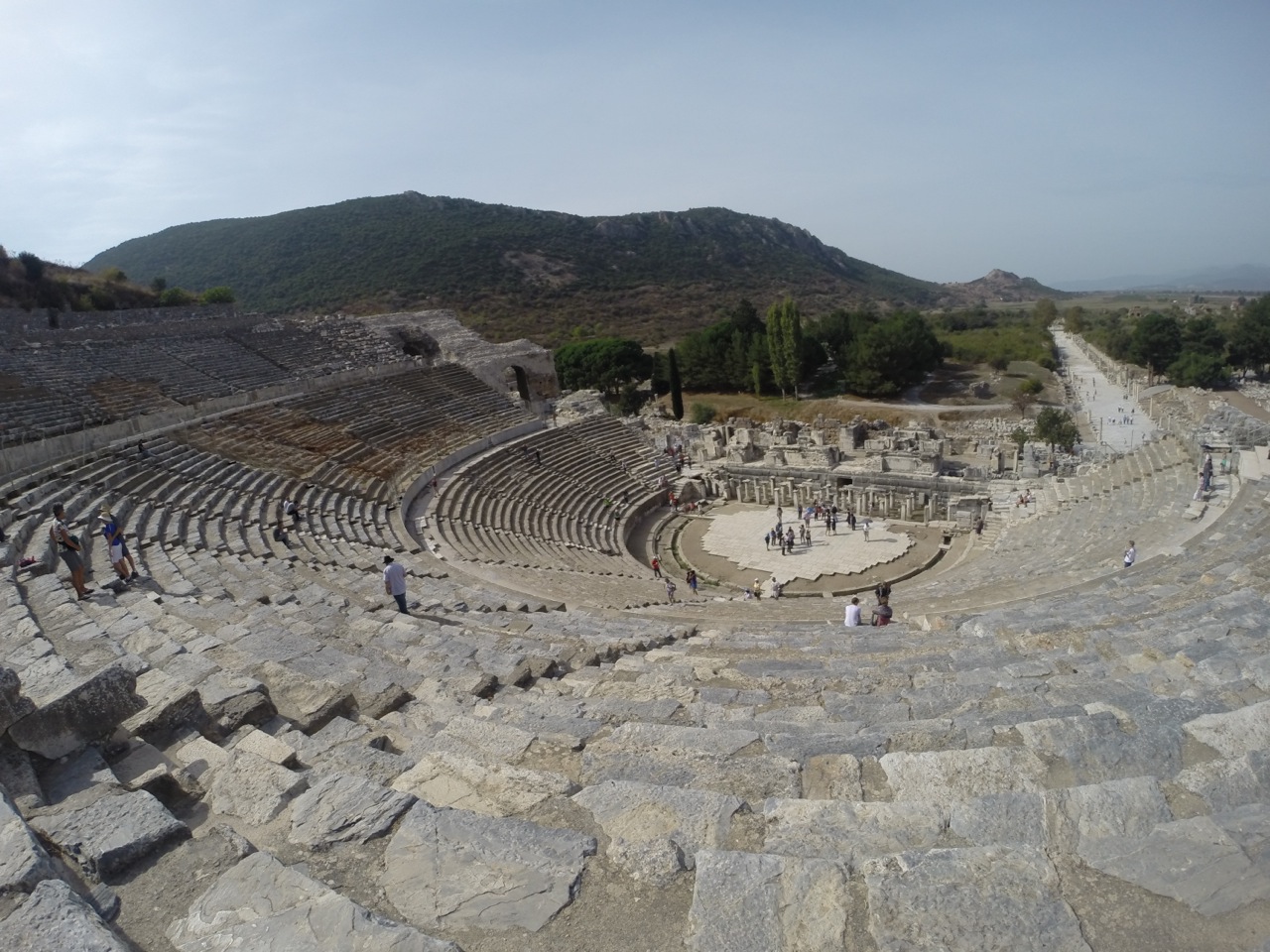
Higher up the slope lies the business and civic centre. The Agora, a market for trade with the whole eastern part of the empire, was begun under Tiberius around AD 23, according to the ministry. The Odeon served both as the city council chamber and as a stage for performances. Further down stands the Great Theatre, and from it a long straight street leads towards the former harbour.
Why the city ended up far from the sea
The TDV Encyclopedia tells the history of Ephesus as the history of a river. The city stood on the shore of a gulf, but silt from the Küçük Menderes gradually filled the shallows, and Ephesus had to move west, following the retreating sea. After Alexander's campaigns it was refounded by Lysimachus; in 133 BC the city passed to Rome and became the capital of the province of Asia. When the harbour silted up too, Ephesus lost its importance.
Life returned to the hill where, in the sixth century, Emperor Justinian built a basilica over the tomb of the Apostle John. From his Greek name, Agios Theologos, the settlement took the name Ayasuluk, and in 1914 it was renamed Selçuk. Earlier still, in 431, an Ecumenical Council met in Ephesus, in the Church of the Virgin Mary. In 2015 UNESCO inscribed a four-part site on the World Heritage List: Çukuriçi Höyük, Ayasuluk Hill with the site of the Temple of Artemis (one of the Seven Wonders of the World), the ancient city and the House of the Virgin Mary.
How much time Ephesus takes and when to arrive
There is no official estimate, so the figures follow the layout of the route. By the editors' estimate, an unhurried walk through the ancient city from one gate to the other takes 2–3 hours, the Terrace Houses about another hour, and the Ephesus Museum in Selçuk roughly the same. If you also want to see the House of the Virgin Mary, these places will fill the whole day.
According to the Türkiye Müzeleri portal as of 7 November 2026, in winter (15 October to 1 April) the ancient city is open from 08:00 to 17:30, and in summer (1 May to 1 October) until 21:30, with the ticket office closing at 21:00; the last entry through the upper gate is at 18:00. The ministry's second portal, muze.gov.tr, shows a single schedule with no seasons, also closing at 18:00, and Türkiye Müzeleri gives no hours for April and early October. So check the times the day before your visit. In summer the long evening lets you move your walk to the hours after the midday heat, and in any season there are fewer people at the gates at opening time.
Getting there and where to stay: Selçuk or Kuşadası
The same İZBAN line that runs to Selçuk passes through Adnan Menderes Havalimanı station, so you can travel from Izmir airport to Ephesus without going into the city. The operator publishes the timetable; check on its website whether your train runs to Selçuk without a change at Tepeköy. In Selçuk, taxis to the gates wait at the rank by the bus station (garaj); there is a similar rank at the ruins, handy for going on from there.
Selçuk suits travellers who come for the antiquities: it has the train terminus, the Ephesus Museum, the Basilica of St John and the İsa Bey Mosque, and it is the closest base to the ruins. Kuşadası is a coastal resort town, chosen when the sea matters on the trip. No official public transport timetable from Kuşadası to Ephesus could be found, so from there plan on a taxi, a hire car or an organised tour.
The House of the Virgin Mary on Mount Bülbül
The domed stone house stands on Mount Bülbül, 9 km from Selçuk; this is the figure given by the Hz. Meryem Ana Evi Derneği association, which runs its official website. In the tradition the association cites, the Apostle John brought Mary to Ephesus a few years after the death of Jesus. The house itself was identified in 1891 by Lazarist priests who were looking for the place described in the visions of the German nun Anne Catherine Emmerich. Since Pope Paul VI's visit in 1967, Mass has been celebrated here every year on 15 August, and Benedict XVI visited the house in 2006. For Christians it is a place of pilgrimage, and the Culture Portal names it as part of the UNESCO site.

There is no public bus to the house, as the association states plainly: you can go by your own car or by taxi from the rank in Selçuk or at the Ephesus ruins. According to the official website, the house is open to visitors from 08:30 to 17:00. Mass is held daily at 07:15, and at 10:30 on feast days. The association does not publish an entrance fee on its website, and as of 7 November 2026 it could not be confirmed from an official source.
What else to see nearby
- The Ephesus Museum in Selçuk: finds from the excavations, including the original friezes of the Temple of Hadrian.
- The Ephesus Experience Museum (Efes Deneyim Müzesi) next to the ruins: an audiovisual account of Roman life, the Temple of Artemis and the Library of Celsus.
- The Basilica of St John and Ayasuluk Castle on the hill in Selçuk: the ministry lists them among the sites near Ephesus.
- The İsa Bey Mosque in Selçuk, built in 1375, according to the TDV Encyclopedia.
- Şirince village in the hills above Ephesus: Greek houses from the nineteenth century, fruit wines and olive oil.
- Izmir Archaeological Museum: sculptures and finds from Ephesus and other ancient cities, if your trip starts in Izmir.
Tickets: what entry to Ephesus costs
According to the Türkiye Müzeleri portal as of 7 November 2026, foreign visitors aged 8 and over pay €40 to enter the ancient city, children under 8 enter free, and Turkish citizens pay 200 TL. For foreigners the ticket also covers the Ephesus Experience Museum. You can buy it at the ticket office or in advance from the ministry's e-ticket office at muze.gov.tr. The Ephesus Museum in Selçuk is a separate site: for foreigners aged 8 and over it costs €10.
The ministry lists the Terrace Houses as a separate site, and the description of the ancient city ticket does not mention them. As of 7 November 2026 the entry price for the houses could not be found on the official portals, so ask at the ticket office at the entrance to the houses.
Is a guide worth it at Ephesus
The choice is yours; the rules are these. Turkey's Tourist Guiding Profession Law No. 6326 (2012) allows only tourist guides licensed by the ministry to provide guiding services. A working guide receives an annual work card from their chamber and must wear it visibly, and the ministry sets the minimum fee for their work. You can check a guide in the public database of the Union of Tourist Guide Chambers (TÜREB), which searches by name, chamber, region and language. The database itself warns that a listing does not mean the guide is currently active.
A guide is for those who care about the links between the buildings and the people who lived in them: without a story, Curetes Street remains a handsome colonnade. Those willing to read up in advance will manage with the ministry's descriptions and the Ephesus Experience Museum, which is included in the ticket for foreigners. gezdir.me does not recommend specific guides or agencies.
FAQ
Is the Müzekart valid at Ephesus?
According to the ministry's page, the Müzekart is valid for Turkish citizens. Foreign tourists buy a regular ticket.
Is there a regional museum pass?
The Türkiye Müzeleri portal offers the Museum Pass The Aegean at €95 for 7 days: according to its description, it covers more than forty museums and archaeological sites in the provinces of Izmir, Aydın, Muğla and Denizli. Check the full list of sites on the pass page before buying.
Sources
- Türkiye Müzeleri (Ministry of Culture): İzmir Ephesus, tickets, hours, gates
- muze.gov.tr (Ministry of Culture): Efes Örenyeri, hours, Müzekart, nearby sites
- muze.gov.tr: e-ticket office
- Türkiye Müzeleri: Ephesus Museum (İzmir Ephesus Museum) and Museum Pass The Aegean
- Türkiye Müzeleri: Ephesus Experience Museum
- İZBAN: line and stations
- Hz. Meryem Ana Evi Derneği: official website of the House of the Virgin Mary
- Hz. Meryem Ana Evi Derneği: visiting hours
- Hz. Meryem Ana Evi Derneği: getting there
- Kültür Portalı (Ministry of Culture): Library of Celsus
- Kültür Portalı (Ministry of Culture): Ephesus, UNESCO site
- TDV İslâm Ansiklopedisi: "Ayasuluk", F. Emecen, O. S. Yücetürk, vol. 4, 1991
- Mevzuat: Law No. 6326 on the Tourist Guiding Profession
- TÜREB: tourist guide database
Photo: Benh LIEU SONG · CC BY-SA 3.0 (https://commons.wikimedia.org/wiki/File:Ephesus_Celsus_Library_Fa%C3%A7ade.jpg)