Grand Bazaar and Spice Bazaar: what to buy and how to bargain
By Gezdir.me editorial team ·

The Grand Bazaar, Kapalıçarşı in Turkish, trades Monday to Saturday: according to the chairman of the market's board, the gates open to visitors at 08:30, and the Grand Bazaar is closed on Sundays. The Spice Bazaar by the Eminönü piers trades all seven days of the week. You can bargain in both, but the bargaining has one reference point: Turkish law requires the seller to show the price including taxes on the item or in a list, and any discount from it is the shop's decision, not a rule. Below: how both markets are laid out, how to agree on a price, how to avoid buying a fake, and what to get at the Spice Bazaar if you are after lokum (Turkish delight), tea and coffee.
A city under vaults: how the Grand Bazaar is laid out
The Grand Bazaar fills a whole quarter between the Beyazıt and Nuruosmaniye mosques in the Fatih district of Istanbul. Its core is two stone covered markets, the bedestens. The inner one, the Cevahir Bedesten, is roofed with fifteen domes, the Sandal Bedesten with twenty. According to the architectural historian Semavi Eyice, writing in the Islamic Encyclopedia of the Türkiye Diyanet Foundation (TDV), the trading centre began to take shape right after the conquest of the city in 1453, under Mehmed II, and the author rejects the theories of a Byzantine origin for the market.
The market took its present form after a series of disasters. The encyclopedia lists fires in 1515, 1546, 1652, 1660, 1701, 1750 and 1826; after the fire of 1702 wooden shops were banned and the market was rebuilt in stone with vaults. The 1894 earthquake brought down some of the vaults, and the repairs under Abdul Hamid II took a year and a half; at the same time the market's boundaries were drawn tighter, and about half of the hans, the trading courtyards, were left outside. The last big fire, in November 1954, destroyed about two fifths of the market, which reopened on 28 July 1959. The stone bedestens with their iron shutters survived almost all the fires.

Each trade once had its own street: jewellers, cloth merchants, cap makers, booksellers. The encyclopedia notes that today the rows are mixed and the old guild customs are no longer kept. In May 2026 the chairman of the market's board, İlhami Yazıcı, described its size to the news channel CNN Türk: about 2,550 shops in the bedestens, about 4,300 including the surrounding hans, and 21 of its 23 gates in use. In his words, jewellery shops, souvenirs, crafts and textiles now make up most of the trade, and carpets and İznik ceramics are especially popular with foreign visitors.
The Spice Bazaar: a market attached to a mosque
The Spice Bazaar (Mısır Çarşısı, literally the Egyptian Bazaar) is younger and simpler in layout. It is an arcade belonging to the New Mosque (Yeni Cami) complex in Eminönü: the mosque was begun in 1598 by Safiye Sultan, mother of Mehmed III, and completed after the fire of 1660 by the valide sultan Turhan Hatice, and in October 1665 it opened for prayer. That is how the complex is described in Ahmet Vefa Çobanoğlu's article in the TDV encyclopedia. At first the market was called the Valide Çarşısı or the New Market, and the name 'Egyptian' has stuck to it since the mid-18th century.
In plan the market is L-shaped: the short wing runs north, the long one stretches south from it, and a domed space stands at the junction. Inside, by the encyclopedia's count, there are 88 shops, with another 18 opening onto the outer side of the short wing, and six gates lead outside. After the fires of 1688 and 1691 the market was repaired more than once, and it got its present appearance in the 1940–1943 restoration. Its smaller size works for the buyer: you can walk the whole bazaar in one loop and compare the same goods in neighbouring shops.

How to bargain and how far the price can come down
Start with the law, not with tricks. Article 54 of Turkey's Consumer Protection Law (No. 6502) requires goods on retail sale to carry a clearly visible price tag showing the final price with all taxes; where a tag cannot be attached, the same information must be on a list in a visible place. So for an item without a price, ask the price first and only then discuss a discount. Whether to lower it is up to the seller: the law provides for no obligatory discount.
There is no honest figure for the size of the discount. Neither the Ministry of Trade nor the bazaars' traders' associations publish a usual rate, and figures like 'bargain down to half' in guidebooks have nothing to back them. Comparison is more reliable than a percentage: if two or three shops ask similar sums for the same item, that is the market price, and the argument is only over a small difference.
- Look at the same item in several shops and note the prices: for lokum, spices and tea compare the price per kilogram, for jewellery the price per piece with the metal and weight stated.
- Check exactly what the price covers: size, quantity, packaging, delivery and currency. A price in lira and a price in euros are different offers.
- Offer your own sum and explain what it is based on: the price in the shop next door or buying several items at once.
- If the price does not suit you, walk away calmly: leaving the shop commits neither you nor the seller.
- Once you agree, repeat the final sum before paying and ask for a receipt (fiş) or invoice (fatura) describing the item. Why it is better to pay by card in lira rather than in your own currency is explained in the gezdir.me article on money in Turkey.
What to buy at the Grand Bazaar and how to avoid fakes
Going by what the market sells today, its main goods are jewellery, carpets and textiles, ceramics, lamps, copperware and souvenirs. Which of these you can take out of the country, and in what quantity, carpets especially, is covered in the gezdir.me article on what to bring back from Turkey; this one is about the purchase itself.
Bags and watches with famous brand logos at souvenir prices are the main reason to be wary. Turkey's Industrial Property Law (No. 6769, Article 30) punishes with one to three years' imprisonment anyone who produces, sells, imports or exports goods bearing someone else's counterfeit trademark, or buys or holds them for trade. The article does not mention buying a fake for yourself, but bringing such an item home is governed by your own country's customs. If the seller insists the item is genuine, ask for the manufacturer's document; if there is none, treat the item as a copy and pay as for a copy.
The receipt is not a formality. If the item turns out not to be as promised (silver of the wrong composition, a machine-made carpet instead of a hand-knotted one), then under Articles 8 and 11 of the same Law No. 6502 it counts as defective goods, and the buyer can return it or demand a price reduction, free repair or replacement. Under Article 12 the limitation period for such claims is two years from delivery of the goods. Without a receipt or invoice it is much harder to prove that you bought that very item in that very shop.
If the shop refuses, the law sends the dispute to a consumer arbitration committee (tüketici hakem heyeti) under the Ministry of Trade. The application is made in writing: in person, by post or through the e-Devlet portal, to the committee for the place of purchase or for your place of residence, and a foreigner needs a passport number instead of a Turkish ID number. For 2026 the committee hears disputes worth up to 186,000 TL; larger cases go through mandatory mediation to the consumer court. These are the figures on the ministry's page as of 7 November 2026.
Lokum, spices, tea and coffee at the Spice Bazaar
The Spice Bazaar sells spices and dried herbs, dried fruit and nuts, among them the Antep and Siirt pistachios mentioned in June 2026 by the head of the bazaar's traders' association, as well as lokum, tea and coffee. For the last three the buyer has official markers that make choosing easier than going by shop signs.
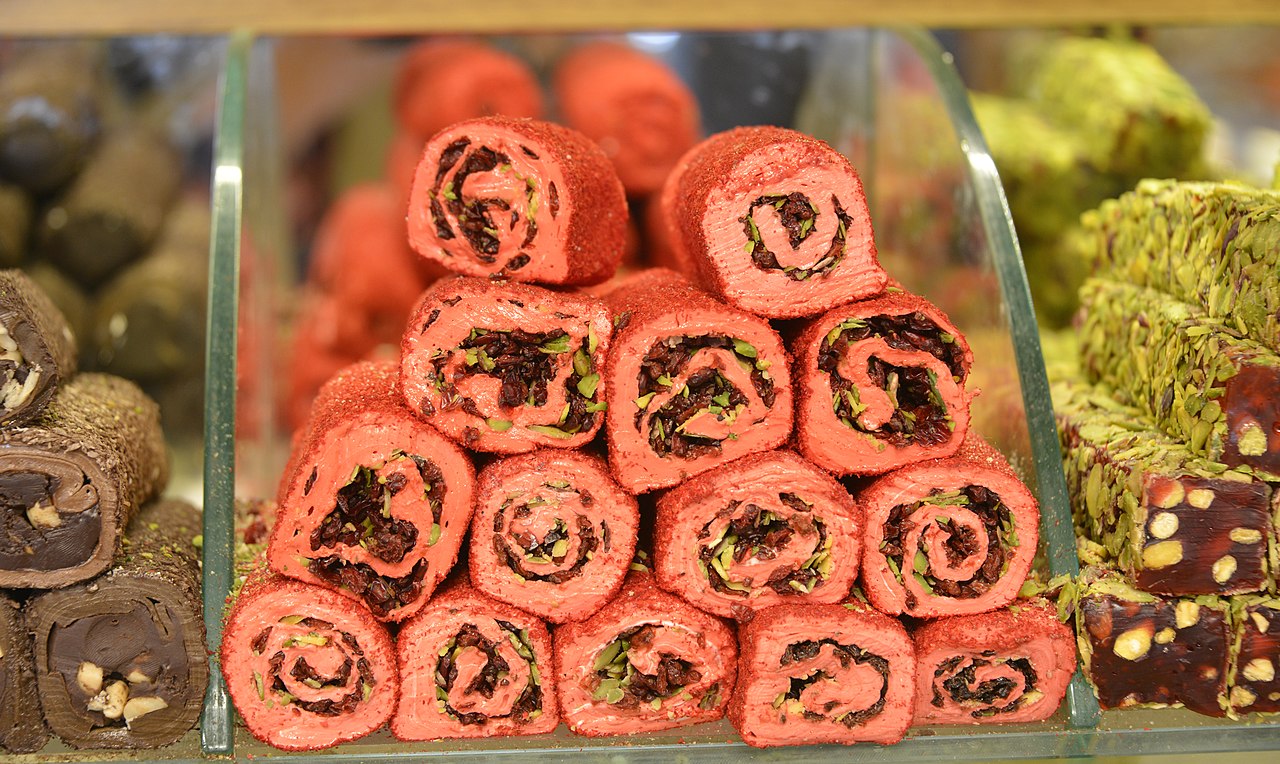
What real lokum is has been written down in the Turkish Food Codex. Under the Communiqué on Lokum (Tebliğ 2013/55), the base is cooked from sugar, starch, water and citric or tartaric acid, and nuts, fruit, kaymak and spices are added to the finished mass. Lokum with nuts or dried fruit must contain at least 12% of them by weight. On the label of flavoured lokum the name of the addition is given together with the product name: 'pistachio', 'with hazelnuts'. The codex requires loose lokum to be kept in closed glass display cases with a label the buyer can see, and to be packed by the seller's own hands. An open tray without a label is a reason to choose another shop.
For tea, the marker is origin. Since 26 March 2021 'Rize Çayı' has been registered with the Turkish patent office TÜRKPATENT as a designation of origin (registration No. 707, applicant the Rize Commodity Exchange), so that name on a packet refers to black tea from that province. Where Turkish tea comes from is told in the article on Rize.
For coffee, the marker is very recent. On 10 March 2026 TÜRKPATENT registered 'Türk Kahvesi / Turkish Coffee' as a traditional product name (registration G8, holder the Union of Chambers and Commodity Exchanges of Türkiye, TOBB). Under the specification it is coffee from roasted arabica or robusta beans or a blend of the two, ground to a powder with particles of 75–125 microns; instant coffee is not used for it. A packet sold under the protected name carries the traditional product logo and emblem, and without the emblem the words 'Turkish coffee' are not protected by the Industrial Property Law. The specification advises keeping ground coffee in airtight packaging for no longer than a year. How it is brewed and ordered in cafés is covered in the gezdir.me article on Turkish food.
Flea and antique markets in Istanbul
If you are after old things rather than souvenirs, look for them outside the covered bazaars. The best-known market of this kind is the Feriköy Antique Market (Feriköy Antika Pazarı) in Bomonti, Şişli: according to the newspaper İstiklal (June 2026), it is held on Sundays. The market is run by Şişli municipality, and, as the DHA agency reported in July 2026, only antiques may be sold on its stalls: a trader caught with other goods is suspended for a week, and after five violations in a year loses the pitch.
- Kadıköy, Asian side: antique shops on Tellalzade Sokak and the neighbouring antique arcade with furniture and interior items, as described by the GoTürkiye portal of the Ministry of Culture and Tourism.
- Dolapdere, European side: a flea market that GoTürkiye recommends visiting early on Sunday morning, warning that the stalls there are set out without much order.
An old object at such a market may turn out to be cultural property whose export from Turkey is banned: in 2017 police seized about 40 objects at Feriköy which, according to İstiklal, were about 3,500 years old, and detained the seller. What may be exported and which documents that requires is covered in the gezdir.me article on safety in Turkey.
Opening hours and how to get there
The Grand Bazaar's exact timetable could not be checked on the market's own website: on 7 November 2026 kapalicarsi.org.tr did not open because of an expired security certificate. So the hours come from the press. In May 2026 the board chairman said the main gates open to traders at 07:30 and to visitors an hour later; he did not give a closing time. The newspaper Fanatik wrote in December 2024 that the market usually closes around 19:00. Individual shops keep their own schedules, and hours may change on holidays.
The Spice Bazaar, according to the head of its traders' association (CNN Türk, June 2026), is open daily, but neither the association nor the city services publish its opening hours. If you are planning a Sunday, build it around the Spice Bazaar or Feriköy and move the Grand Bazaar to another day; the easiest way to spread the days is in the gezdir.me itinerary planner.
Tram T1 takes you to the Grand Bazaar (stop Beyazıt–Kapalıçarşı), and the same tram to the Spice Bazaar (stop Eminönü). Walking between the bazaars is easy: from the Grand Bazaar's northern gates the shopping streets run downhill straight to Eminönü, so the way back is best started from the Spice Bazaar by tram. Fares are paid with an Istanbulkart.
FAQ
Can you return an item in working order if you simply change your mind?
Law No. 6502 gives a special right of withdrawal for distance contracts, that is, purchases made online or by phone. For a purchase in a shop the law has no such general right: exchanging an item in working order depends on the seller, so agree on it before paying.
Can you get Tax Free at the bazaar?
Only in a shop that has a permit from the tax administration or a contract with an intermediary company. How the VAT refund works is covered in the gezdir.me article on money in Turkey; ask about it before you pay.
Sources
- TDV İslâm Ansiklopedisi: “Büyük Çarşı”, Semavi Eyice, vol. 6, 1992
- TDV İslâm Ansiklopedisi: “Yenicami Külliyesi”, Ahmet Vefa Çobanoğlu, vol. 43, 2013
- CNN Türk: Grand Bazaar, interview with the board chairman, 19 May 2026 (in Turkish)
- CNN Türk: Spice Bazaar, 17 June 2026 (in Turkish)
- Fanatik: Grand Bazaar opening hours and Sunday closure, 31 December 2024 (in Turkish)
- Consumer Protection Law No. 6502 (mevzuat.gov.tr, in Turkish)
- Industrial Property Law No. 6769 (mevzuat.gov.tr, in Turkish)
- Ministry of Trade of Türkiye: consumer arbitration committees (in Turkish)
- Resmî Gazete No. 28763, 12 September 2013: Turkish Food Codex Communiqué on Lokum 2013/55 (FAOLEX copy)
- TÜRKPATENT: Rize Çayı, designation of origin No. 707
- TÜRKPATENT: Türk Kahvesi / Turkish Coffee, traditional product name G8 (PDF)
- İstiklal: Istanbul's antique markets, 23 June 2026 (in Turkish)
- DHA: Feriköy Antique Market rules, 23 July 2026 (in Turkish)
- GoTürkiye: antique and flea markets of Türkiye
- İstiklal: antiquities seized at Feriköy market, 8 August 2017 (in Turkish)
Photo: Mehmettas9444 · CC0 1.0 (https://commons.wikimedia.org/wiki/File:Nuruosmaniye_Kap%C4%B1s%C4%B1.jpg)