Evening and Asian-side Istanbul: Kadıköy, Moda, Üsküdar, Kuzguncuk
By Gezdir.me editorial team ·

In Kadıköy, the things to see are the market streets by the Osman Ağa Mosque, pedestrian Bahariye with the Süreyya Opera House, the mural-covered walls of Yeldeğirmeni and the neighbouring district of Moda. This is the main part of the Asian shore of Istanbul for an evening out: from here it is not far to Üsküdar, where people watch the sunset by the Maiden's Tower, or to quiet Kuzguncuk on the Bosphorus. Save the tower itself and Çamlıca Hill for the daytime: boats to the islet run only during the day, and the hill is best climbed while it is still light. Below: what to see in each district, what the tower costs and how to get back to the European side late in the evening.
Kadıköy: the market, Bahariye and the mural streets
Kadıköy has the longest history on this shore. In antiquity this was Chalcedon, and in 451 it hosted the Council of Chalcedon, the fourth Ecumenical Council of the Church. The present name, "the judge's village", appeared only after the Ottoman conquest of 1453. Almost nothing of the ancient city can be seen: today Kadıköy is a dense residential and shopping district that lives its own life rather than one put on for tourists.
Start at the pier. The market lanes begin by the Osman Ağa Mosque, and Wikipedia describes this as one of the largest food markets in Turkey: fish, spices, cheeses, pickles and sweet shops. The streets climb to the Altıyol junction ("six roads"), marked by a bronze bull statue, the informal edge of the district's shopping centre. The pedestrian street Bahariye leads off from Altıyol.
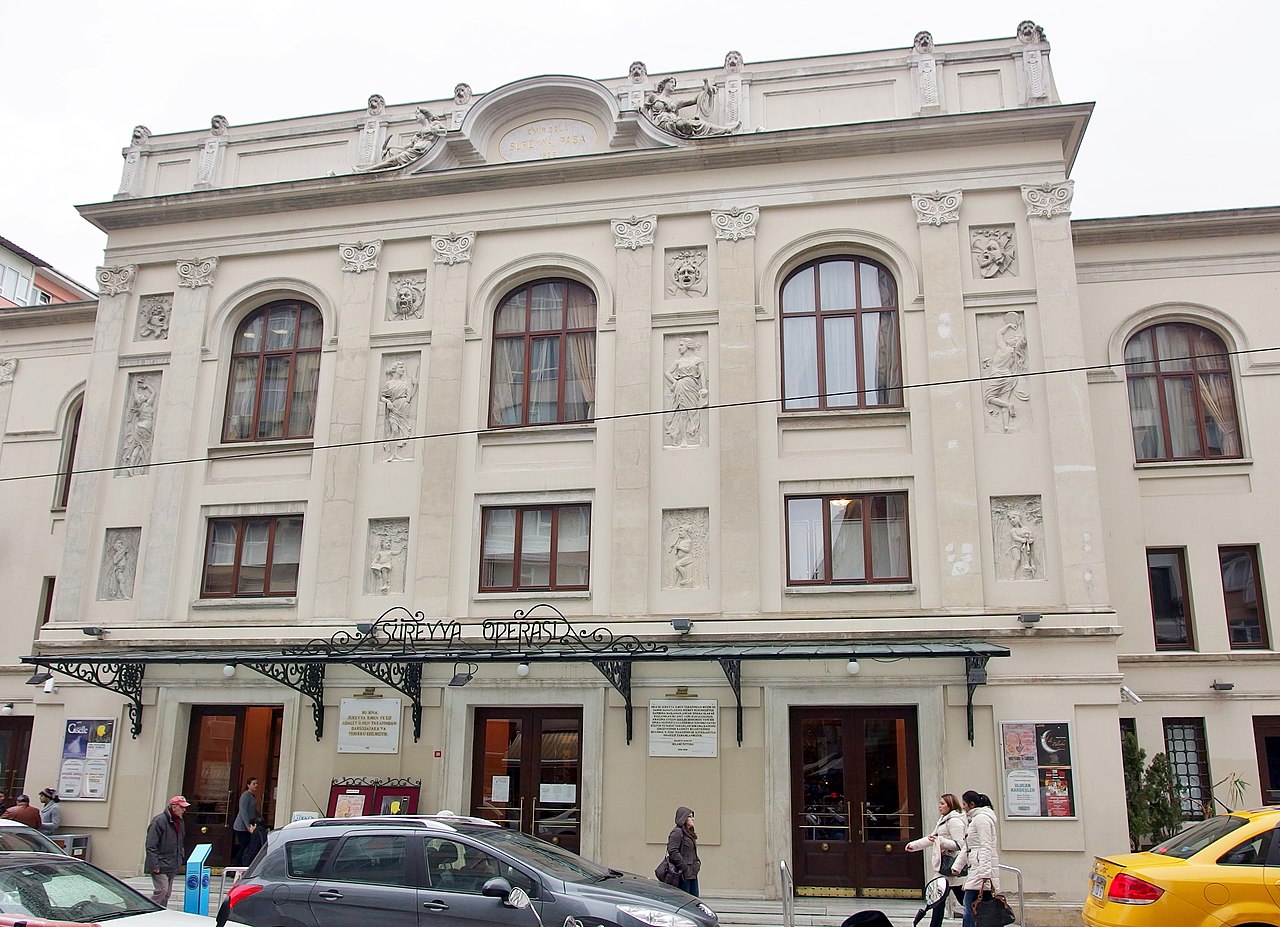
Bahariye is home to the Süreyya Opera House. The building was put up in 1927 by the Armenian architect Kegham Kavafyan, commissioned by Süreyya İlmen, a member of parliament for Istanbul; for most of the century it housed a cinema, and it became an opera house only after restoration, in December 2007. It was the first opera venue on the Asian side of the city, and the Istanbul State Opera and Ballet performs here today. The façade with its reliefs is worth seeing even if you are not going to a performance.
North of the pier lies Yeldeğirmeni, an old neighbourhood that GoTürkiye describes as bohemian, with cafés and breakfast spots. The Mural İstanbul festival has been held here every year since 2012, and the walls of the buildings are now covered with large paintings. Look for them on Karakolhane Street and in the lanes of Misak-ı Milli and Reşit Efendi; walking among them is like a picture hunt around the neighbourhood, only with no tickets and no opening times.
Moda: the cape, a 1917 pier and the heritage tram
Moda occupies the peninsula south of central Kadıköy, as far as the Kurbağalıdere stream. It became a residential area late, after the 1870s, when wealthy non-Muslim families began building mansions here; that is why Armenian, Greek and Anglican churches, old schools and theatres stand side by side in the neighbourhood. GoTürkiye calls Kadıköy and Moda one of the city's cultural centres, with plenty of places for art and music.
The Moda waterfront is known above all for its view over the water to the old city on the far shore. At its edge stands a passenger pier built in 1917 and restored in 2022. From the Kadıköy pier you can get here on foot through the shopping streets or on the T3 heritage tram.
- Line T3 opened in 2003 and runs as a 2.6 km loop with ten stops: from Kadıköy square through Moda and back.
- All trams go round the loop in one direction, clockwise, so the tram will take you back to the pier only if you ride the full circle.
- The line is run by Metro İstanbul; you pay with an Istanbulkart, as on the rest of the public transport.
Üsküdar and sunset by the Maiden's Tower
Üsküdar is an old Ottoman district north of Kadıköy, and its look is set by its mosques. Right by the pier stands the Mihrimah Sultan Mosque, which Mimar Sinan built in 1548 for the daughter of Süleyman the Magnificent and Hürrem Sultan. The same district has the Şemsi Paşa Mosque of 1580 and the Atik Valide Mosque, another work by Sinan, from 1583. gezdir.me covers the rules for visiting mosques and the dress code separately; check the prayer times before your visit.
In Üsküdar the sunset is watched from the Salacak waterfront, which runs from the district towards Harem along the shore opposite the Maiden's Tower. GoTürkiye calls the sunset by the tower the most popular thing to do in Üsküdar, for locals and visitors alike: people sit on the steps by the water with tea and chat. Come early, especially at weekends: the steps get crowded towards sunset, and at that hour the domes of the historic peninsula darken behind the tower.
Maiden's Tower: tickets, boats and opening hours
The Maiden's Tower (Kız Kulesi) stands on a rock about 200 metres off the Salacak shore. For centuries the rock served to keep watch over shipping, and most of the present buildings date from the reign of Sultan Mahmud II, in 1832–1833. At the same time the tower was turned into a quarantine hospital against cholera, and in 1836–1837 plague patients were isolated here. The Western name "Leander's Tower" comes from the ancient legend of Hero and Leander, which 18th-century travellers moved here from the Dardanelles. Today the tower is managed by the Ministry of Culture and Tourism and is open as a monument and museum.
- A ticket without the Museum Pass Türkiye card costs, as of 7 November 2026, €27 for entry and €8 for the audio guide, €35 in total; the boat trip is not included in this sum.
- With the Museum Pass Türkiye entry is free, but the transfer is paid separately: the tower's website gives 110 TL.
- Boats leave from both shores: from Salacak (Harem) and from Karaköy, from the pier opposite the Ziraat Bankası branch. Sailings from Salacak are more frequent and those from Karaköy less so, but the Karaköy boat lets you reach the tower from the European side without crossing to Üsküdar.
According to Türkiye Müzeleri, as of 7 November 2026 the tower is open every day from 09:00 to 18:00, and the ticket office closes at 17:00. Boats from Salacak and Karaköy run from 09:30; the last boat to the tower leaves at 17:00 and the last one back at 17:45. The timetable may change in bad weather, so on a windy day check it before setting out.

Kuzguncuk: a mosque in the grounds of an Armenian church
Kuzguncuk lies on the Bosphorus shore north of Üsküdar, and the main thing to see here is how the places of worship of different communities stand side by side. Until the mid-20th century there was no mosque in the centre of the neighbourhood. The Kuzguncuk Mosque was built in 1952 next to the Armenian church of Surp Krikor Lusavoriç, and, as the newspaper Hürriyet wrote, the Armenian community gave the land for it from its church gardens. The church itself opened in 1835 as a wooden building and was rebuilt in stone in 1861.
The easiest way into the neighbourhood is along the main street, from the İcadiye side. Hürriyet described the route like this: on the left soon after you enter is the Beth Yaakov synagogue (from 1878, according to Wikipedia), further on the left the Greek church of Ayios Yeorgios, and further still on the right the church of Ayios Panteleimon. Nearby is a former vegetable plot turned into a community garden: in 2015 the newspaper wrote that its 86 small beds had been handed out to residents by lottery. This is a lived-in residential neighbourhood, so behave as a guest in the places of worship and near the houses.

Kuzguncuk often appears in Turkish TV series; which ones were filmed here, and which of the locations are private homes, is covered in the gezdir.me article on Istanbul's filming locations.
Çamlıca Hill: how to get up there
Büyük Çamlıca is the highest hill on the Asian side, and the easiest way up is by metro. Line M5 runs inland from Üsküdar; get off at Kısıklı station, which lies under Kısıklı Avenue at the southern foot of the hill. From there an uphill walk leads to the top, so comfortable shoes will come in handy. The station, like the whole line, is run by Metro İstanbul.
Two buildings on the hill can be seen from almost everywhere. GoTürkiye calls the Çamlıca Mosque the largest in Turkey: it has six minarets and a main dome 72 metres high. Next to it is the Çamlıca Kulesi TV tower with an observation terrace. Its opening hours and ticket price as of 7 November 2026 could not be confirmed: no official website for the tower could be found, and third-party pages disagree, so check them on site.

Evenings: live music, rooftop bars and clubs
Live music in Istanbul is most reliably found in the programmes of concert halls and festivals. The main festival organiser is the İKSV foundation: it holds a film festival in spring and a music festival and a jazz festival in summer. In 2026 the Istanbul Music Festival ran from 11 to 25 June; the foundation publishes the next season's dates on iksv.org. Concerts take place all year round in its own venue, Salon İKSV. On the European side, street musicians play on İstiklal Avenue, and GoTürkiye also mentions bars with live music around it.
There is no official ranking of rooftop bars, and gezdir.me does not rank venues. GoTürkiye names the areas where such places are concentrated: Beşiktaş, Galata, Pera, Harbiye and Bebek on the Bosphorus. Prices in them vary widely, so look at the menu before ordering.
The same goes for clubs: no official list names a best-known one. According to GoTürkiye, clubs with Bosphorus views and guest DJs are concentrated in Kuruçeşme, Ortaköy and Bebek, while Kadıköy has underground clubs, pubs, wine bars and restaurants with live music. Night-time risks, including inflated bar bills, are covered in detail in the gezdir.me article on safety in Turkey.
A Turkish night with belly dancing is most often offered to tourists as a dinner on the water: evening Bosphorus cruises include oriental and folk dances in their programme, and an example with the operator's prices is set out on the Bosphorus cruise page. On land, shows are put on by restaurants and hotels; there is no official list of such programmes, so before paying find out what the price includes: dinner, drinks, transfer.
How to get to the Asian side and back in the evening
- The ferry is the simplest option: boats run from Eminönü, Karaköy and Kabataş to Kadıköy and Üsküdar, and you pay with an Istanbulkart; the lines are described in detail in the article on Bosphorus trips.
- Marmaray is a commuter railway in a tunnel under the strait: it reaches Üsküdar from the European side and does not depend on the weather on the water.
- Between Kadıköy and Üsküdar: take the M4 metro from Kadıköy one stop to Ayrılık Çeşmesi, change there to Marmaray, and the next station is Üsküdar.
A late evening needs a plan for the way back. Under the Şehir Hatları 2026/27 winter timetable, night sailings on the Kadıköy–Karaköy–Beşiktaş line run only on the nights from Friday to Saturday and from Saturday to Sunday, as the newspaper Cumhuriyet reported on 3 September 2026. On other days, after the last ferry, Marmaray and taxis remain; how to order a taxi and what it costs is explained in a separate gezdir.me article.
Sources
- Türkiye Müzeleri: Maiden's Tower, opening hours, price, boats and timetable
- Kız Kulesi (Ministry of Culture and Tourism): visiting and the Museum Pass
- GoTürkiye: Üsküdar
- GoTürkiye: Kadıköy
- GoTürkiye: entertainment and nightlife in Istanbul
- Hürriyet: Kuzguncuk, 23 May 2015 (in Turkish)
- Wikipedia: Surp Krikor Lusavoriç Church in Kuzguncuk
- Wikipedia: Kuzguncuk
- Wikipedia: Kadıköy
- Wikipedia: Moda
- Wikipedia: Süreyya Opera House
- Wikipedia: T2 and T3 heritage tram lines
- Wikipedia: Kısıklı station on line M5
- Wikipedia: M4 metro line
- Wikipedia: Ayrılık Çeşmesi station (Marmaray and M4)
- İKSV: festivals and Salon İKSV
- Cumhuriyet: Şehir Hatları winter timetable and night sailings, 3 September 2026 (in Turkish)
Photo: Kurmanbek · CC BY-SA 4.0 (https://commons.wikimedia.org/wiki/File:Kad%C4%B1k%C3%B6y_Pier_and_%C5%9EH-Fatih_ferry.jpg)