What to bring back from Turkey: lokum, tea, carpets, ceramics and gold, and how to take it all home
By Gezdir.me editorial team ·
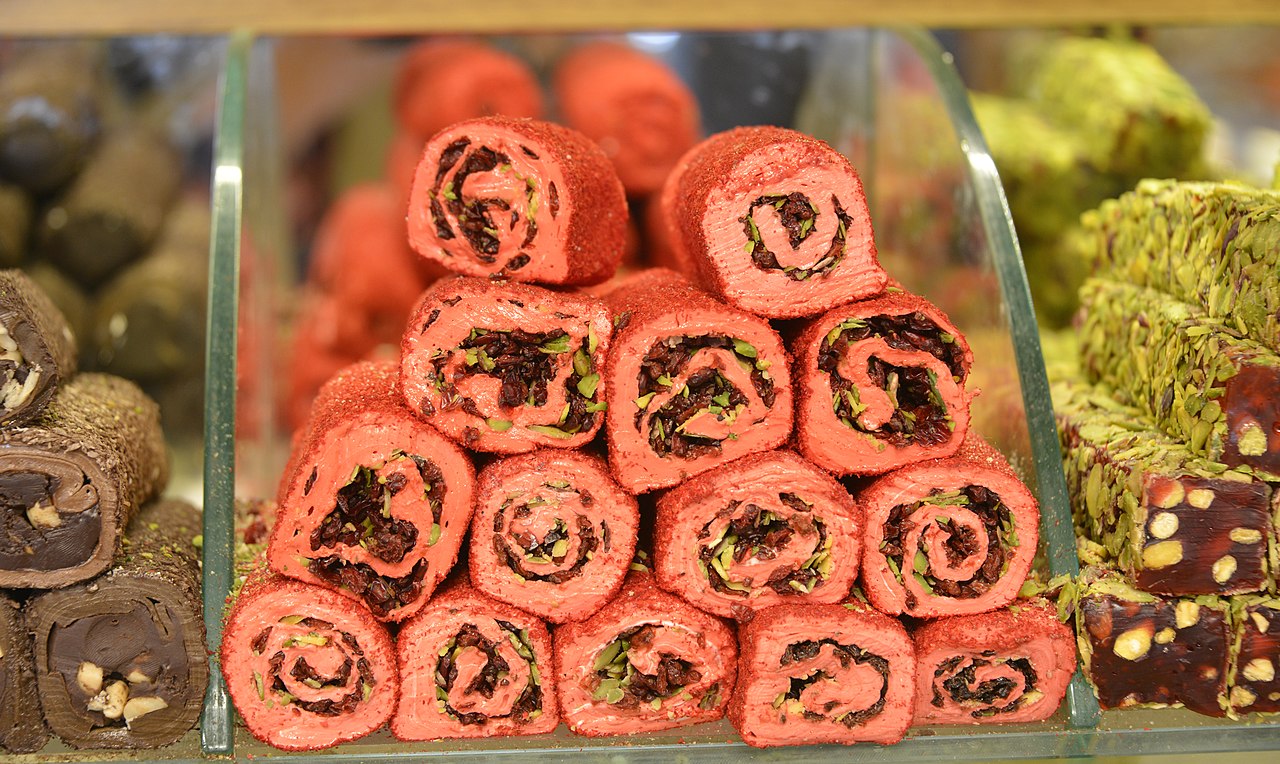
The most reliable gifts from Turkey are the ones whose origin you can check. The Turkish patent office TÜRKPATENT keeps a register of geographical indications, and it holds almost the whole classic tourist shopping list: lokum (Turkish delight) from Afyon and Safranbolu, tea from Rize, Kütahya ceramics, Uşak carpets, Buldan cloth. The indication mark on a package or product means the item was made to a published specification, and a commission checks that the specification is followed. After that the rules decide: honey, jam and oil are limited in hand luggage, antiques may not be taken out of the country, and the export of an old carpet or another ethnographic item is checked by a museum of the Ministry of Culture and Tourism.
How to read a geographical indication mark
Under Industrial Property Law No. 6769 (Article 34), indications come in two kinds. A menşe adı, or designation of origin, goes to a product whose every stage of production and processing takes place within the named region. For a mahreç işareti, or indication of source, it is enough that at least one stage takes place in the region. That makes menşe adı the stricter of the two: it is not just a brand with a town's name, but a promise that everything was made locally.
Each indication's specification states where the mark must appear. Usually that is the product itself or its packaging; where this is not possible, the mark is displayed prominently in the workshop or shop. The mark does not say a product tastes better or looks nicer than others: it only confirms that the item was made by the rules of its region. For a gift this is often enough, because nobody checks words like "natural" and "traditional" on an ordinary box.
Lokum: which one counts as the best
There is no official ranking of lokum, and the word "best" on a box belongs to the seller. There are, however, two protected specifications. "Afyon Lokumu" was registered in 2021 on the application of the Afyonkarahisar municipality. It is made from white sugar, natural corn starch and citric acid, and the specification expressly forbids glucose and cane sugar. The mixture is rolled out and cut on marble, and it comes in four types: plain or flavoured cubes, the "sultan" roll with kaymak (clotted cream) or nuts, a filled roll, and cubes with nuts worked into the hot mixture.
"Safranbolu Lokumu" was registered in 2014 on the application of a local producer. Under the specification it is boiled in a copper cauldron with groundwater from the Safranbolu district and made by masters with at least five years' experience, and the classic piece is a cylinder about two centimetres thick with at least one hazelnut inside. There are also versions with rose, mastic, pistachio and saffron.
That gives a practical way to choose: look for the indication mark on the package and read the ingredients. If glucose syrup comes first after sugar, it is not lokum by the Afyon rules, though it may well taste good. How to buy sweets in the Spice Bazaar and bargain there is covered in a separate gezdir.me article on Istanbul's bazaars.

Tea, pistachios and other products with a home region
"Rize Çayı" is a designation of origin: black tea from leaf grown and processed in Rize province. The Rize Commodity Exchange registered it in 2021, and the mark reading Rize Çayı goes on the packaging. The specification explains why the garden and the factory must be close together: a picked leaf starts to spoil at once and has to reach processing quickly. So a packet with the mark holds tea that has not been carried across half the country.
The Antep pistachio (Antep Fıstığı) is protected too: in the specifications of other products TÜRKPATENT refers to it as geographical indication No. 27, and it is the pistachio required, for example, in Afyon lokum with pistachio. Its home is Gaziantep. If you want to bring back nuts or pistachio sweets, the name Antep on the package is a clear pointer, and the indication mark is the confirmation.

Carpets: how to choose one and whether you can take it out
A carpet is the most expensive purchase on this list and the hardest to check. Measurable benchmarks can be found in the specifications of carpets with a geographical indication. For example, "Uşak Halısı", registered by the Uşak Chamber of Commerce and Industry, requires the Turkish symmetrical knot (the so-called Uşak double knot), between 675 and 2,000 knots per square decimetre and a pile 5–7 mm high of pure wool coloured with natural or metal-complex dyes. Compliance is checked by a commission made up of the chamber, Uşak University and the provincial directorate of culture and tourism.
Even if the carpet is not from Uşak, ask the seller to write the same parameters on the receipt: knot type, density, pile and warp material, dyes. That way you know what you are paying for, and you have a document if there is a dispute. VAT on a carpet can be reclaimed under the general Tax Free rules, which are explained in the gezdir.me article on money in Turkey.
For a new carpet, the Turkish customs pages for passengers give no separate export procedure: as of 7 November 2026 they describe only import allowances. Old carpets are another matter. Law No. 2863 (Article 24) allows ethnographic items to be bought and sold freely within the country, but their export is checked by museums of the Ministry of Culture and Tourism or by its specialists at some customs posts. An item found not to be exportable is returned to its owner on condition that it stays in Turkey. So for an old carpet or kilim, ask before paying whether it has passed such a check. Antiquities and other protected ancient objects may not be taken out at all; the penalties are explained in the gezdir.me article on safety in Turkey.

Towels, peştamal and silk
One of the known centres of hand weaving is Buldan in Denizli province. "Buldan Bezi" cloth is protected as an indication of source on the application of the Buldan Chamber of Commerce. Under the specification it is a very fine fabric of twisted yarn, mostly cotton, less often linen, wool or silk. It absorbs moisture well, and after washing in hot soapy water it shrinks in width and takes on a characteristic crinkled texture, so it clings less to the body.
The same specification says that Buldan still weaves peştamal (thin wrap towels), bedspreads and other fabrics on hand and power looms. In Istanbul, peştamal and towels are sold in the shops of the Grand Bazaar.
Ceramics: the stamp under the glaze
"Kütahya Çinisi" was registered in 2005 on the application of the Kütahya ceramists' trade chamber. The specification requires the indication mark to be stamped into the wet clay while the piece is being shaped, so that it ends up under the glaze and does not wear off, and always together with the producer's name or brand. So look for the genuine stamp on the piece itself, under the glaze, not on a sticker.
The same specification has a rule that matters to buyers: ceramics with lead in the glaze must not be used as tableware, only as decoration. If you are choosing a plate or bowl to eat from, ask the seller whether it is meant for food, and ask for this to be written on the receipt.

Gold and jewellery
Gold jewellery in Turkey is sold by weight and fineness (ayar). In April 2026 the Istanbul Jewellers' Chamber (İKO), as reported by NTV, advised buyers to:
- ask for the item's weight in grams, its fineness and details of any stones;
- be careful with jewellery that has no certificate;
- take an invoice (fatura): without one, the chamber warns, there is nobody to complain to;
- buy from well-known jewellers registered with the chamber and in the tax system;
- treat offers that look too cheap with suspicion.
There are many jewellery shops in the Grand Bazaar and, for example, on Kunduracılar Street in Trabzon. We do not give a price per gram: it follows the gold price and the lira exchange rate. Jewellery is no obstacle at the border: according to the Turkish customs questions and answers, a passenger may bring precious-metal jewellery with no commercial purpose worth up to $15,000 into Turkey and take it out again.

Shopping centres, outlets and sales
Istanbul has plenty of shopping centres: according to a report by the valuation company İstanbul Gayrimenkul Değerleme, summarised by TGRT Haber on 24 April 2026, there were 134 of them by the end of 2025, more than in any other province. We found no single ranking by floor area: centres quote either gross or leasable area, and their figures cannot be compared, so we do not name "the largest". There is no official list of outlets either; if a centre calls itself an outlet, check the brands and discounts on its own website.
The Ministry of Trade's rules on discount sales set no sales season: a shop can announce a discount at any time. However, from 1 August 2026, as the ministry announced, the "price before discount" on a price tag must be the lowest price of that item in the 10 days before the sale starts. If yesterday's price on the label suddenly went up just before a discount, that is a violation, not generosity.
There are no official statistics for tourists on whether clothes are cheaper in Turkey: we found no international price comparison, and the result depends on the lira rate on the day of purchase and on your bank's fees. The honest way to decide is to convert the lira price on the tag into your own currency and compare it with the same item at home. For a large purchase in a shop that offers Tax Free, factor in the VAT refund as well.
What you can take on the plane
Hand luggage rules are set by the airport and the airline. Under Istanbul Airport's rules, in force since 1 April 2012, liquids, aerosols and gels are allowed in hand luggage in containers of up to 100 ml, packed in one transparent bag of up to 1 l (20 × 20 cm) per passenger. The airport counts food as liquid too: honey, jam, yoghurt, pekmez (grape molasses), tomato paste, and also oils. So a jar of honey or a bottle of olive oil goes in the hold.
- Purchases from duty-free shops at the airport or on board are allowed in a sealed bag (STEB); it must not be opened before security screening.
- Drinks and liquids above 70% alcohol, such as cologne, are classed by the airport as flammable and not allowed in hand luggage; check the rules for checked baggage with your airline.
- Dry foods (lokum, tea, spices, nuts) are not mentioned in the airport's list of restrictions; if in doubt, put them in your checked baggage.
- What you may bring into your home country is decided by the customs of your destination: check its rules on food before you buy.
FAQ
Where can I check whether a product has a geographical indication?
In the TÜRKPATENT register at ci.turkpatent.gov.tr. Each entry there shows the registration number, the applicant, the type of indication and the full text of the specification with a description of the mark.
What does a shop face for a fake discount?
The Advertising Board of the Ministry of Trade can stop such advertising and fine the seller. According to the ministry's announcement of 2 September 2026, the fine ranges from 108,370 to 39,916,524 TL depending on the advertising medium and the seriousness of the violation.
Sources
- Industrial Property Law No. 6769, Article 34 (in Turkish)
- TÜRKPATENT: geographical indication Afyon Lokumu, No. 655 (in Turkish)
- TÜRKPATENT: geographical indication Safranbolu Lokumu, No. 183 (in Turkish)
- Rize Commodity Exchange: Rize Çayı specification, No. 707 (in Turkish)
- TÜRKPATENT: geographical indication Uşak Halısı, No. 152 (in Turkish)
- TÜRKPATENT: geographical indication Buldan Bezi, No. 194 (in Turkish)
- TÜRKPATENT: geographical indication Kütahya Çinisi, No. 77 (in Turkish)
- Law No. 2863 on the Protection of Cultural and Natural Property (in Turkish)
- Turkish Ministry of Trade: passenger allowances, 3 March 2026 (in Turkish)
- NTV: the Istanbul Jewellers' Chamber on buying gold, 26 April 2026 (in Turkish)
- TGRT Haber: the number of shopping centres in Turkey and Istanbul, 24 April 2026 (in Turkish)
- Turkish Ministry of Trade: inspections of discount advertising, 2 September 2026 (in Turkish)
- Istanbul Airport: security and baggage restrictions (in English)
Photo: Miomir Magdevski · CC BY-SA 4.0 (https://commons.wikimedia.org/wiki/File:Sweets_on_Spice_Bazaar_in_Istanbul_02.jpg)